Starling · statement conversion
Convert Starling bank statements to Excel, Xero or QuickBooks
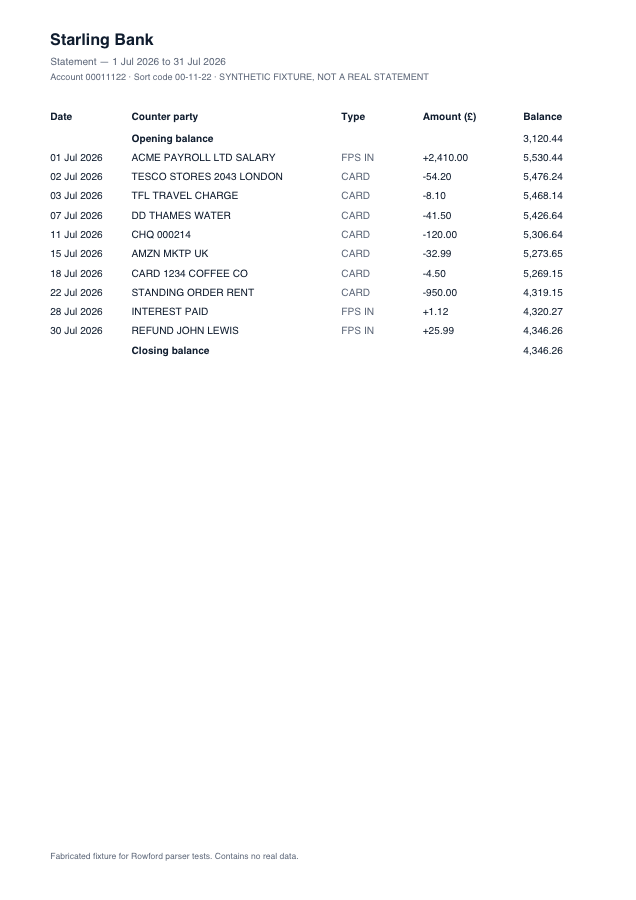
Starling statements name their narrative column “Counter party” and add a separate Type column (FPS IN, CARD, DD) beside a signed Amount. Rowford’s Starling template maps Counter party as the description and reads the signed amounts directly, verifying each against the running balance.
Full preview & reconciliation free · export from $39 one-time · nothing uploaded
How Rowford reads a Starling statement
The Starling template matches the columns as Starling prints them — a single signed amount column, with the sign verified against the running balance:
DateCounter partyTypeAmount (£)Balance
- “Counter party” — vocabulary unique to Starling among UK banks — is the detection anchor and becomes the description column.
- The Type column (FPS IN, CARD, DD) is positional metadata; v1 keeps the counter-party text as the exported description, which is what reconciliation in Xero/QBO matches on.
- Signed amounts are cross-checked against balance movement, the same arithmetic guard used for Monzo.
What ends up in your export
Date (re-formatted per target: dd/mm/yyyy for Xero, QuickBooks, Sage and FreeAgent), the full description as printed, the signed amount, and — in the generic CSV and Excel formats — the running balance. Every row carries a confidence score in the preview, and the whole statement must reconcile (opening + transactions = closing) before you rely on it. Deterministic, template-based extraction: the same statement produces the same output, every time.
Starling questions
Which Starling statements work?
PDF statements from Starling personal and business accounts using the Counter party / Type / Amount layout. Scanned documents are refused.
Where does the Starling Type column go?
It is read but not exported in v1 — exports carry the counter-party narrative, which is what accounting software matches contacts on. If you need the type codes in exports, tell us; it is a small addition.
Business and personal Starling statements — both fine?
Yes. Both use the same column vocabulary, and both go through the same reconciliation check before export.